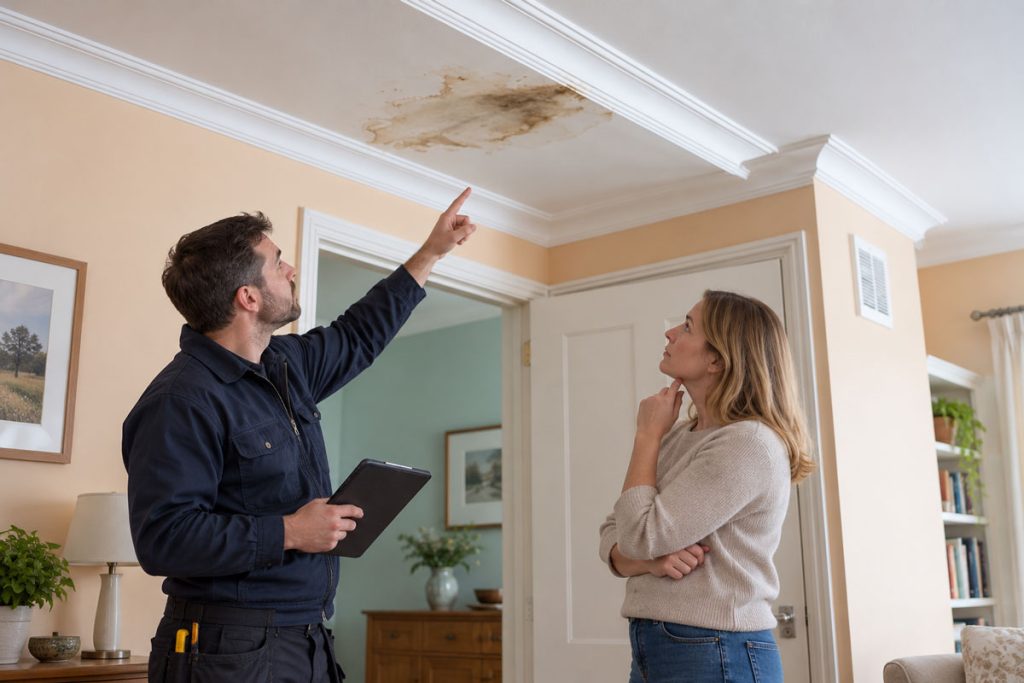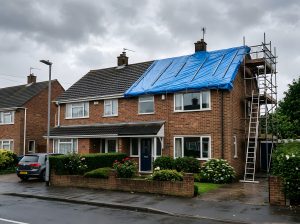
A brown mark on the ceiling is often the first sign that water is getting into your home. It might start as a faint ring above a bedroom window or a darker patch beside the chimney breast. After another spell of rain, it becomes harder to ignore.
The natural assumption is that the roof is leaking directly above the stain. Sometimes it is. Often, though, water has travelled some distance before reaching the ceiling.
Finding the source means following that route back to where water first entered. Simply repairing the roof above the mark can miss the real problem.
Why the Stain May Be Away from the Leak
Once rainwater gets beneath a roof covering, it does not necessarily fall straight down.
It can run along the underside of roofing materials, follow a rafter or move across underlay before finding a gap. Insulation may absorb some moisture, delaying the appearance of a visible stain.
The water eventually emerges where it can pass through the ceiling. That might be at a plasterboard joint, around a fitting or beside a wall.
For example, rain entering near a chimney could follow a timber before dripping onto the ceiling further down the roof slope. The resulting patch may appear to have little connection with the chimney.
This is why leak tracing involves examining the surrounding roof and its construction, rather than concentrating solely on the stained area.
What the Stain Can Tell You
The position and appearance of a damp patch provide useful clues, although neither proves the cause.
A stain beside a chimney breast may suggest a problem around the chimney or its flashing. Damp where an extension meets the original house could point towards the roof junction.
Timing helps too. Does the mark grow during prolonged rainfall, or only when rain arrives from a particular direction? Did it appear after strong winds? Has it returned despite an earlier repair?
Photographs taken over time can show changes that are less obvious from memory.
Avoid painting over the stain before investigating. Fresh paint may hide the evidence temporarily, but it will not stop water entering.
Could Something Other Than the Roof Be Responsible?
A ceiling stain does not always come from a roofing defect.
Plumbing leaks, condensation and water escaping from an upstairs bathroom can produce similar symptoms. Even a mark on an upstairs ceiling may have a cause within the loft, such as leaking pipework.
The relationship with the weather is a useful starting point. A patch that worsens after rain may suggest a roof leak, but that observation still needs checking.
Condensation can complicate matters, particularly where ventilation is limited. A careful assessment should consider plausible alternatives before recommending roofing work.
Repairing an unrelated roof detail would leave the actual problem unresolved.
Checking Tiles and Slates
Broken, slipped or missing tiles and slates are obvious places to investigate. They can expose the layers beneath and allow rainwater to reach vulnerable areas.
However, visible damage is only part of the picture. A tile may be cracked without being noticeably displaced, while faults around edges and fixings can be difficult to spot from ground level.
The condition of the underlay also matters. It provides a secondary route for managing water that gets beneath the outer covering, but damage or deterioration can interrupt that protection.
A roofer will consider how water could pass through the covering and where it might travel afterwards. Finding one cracked tile does not automatically establish that it caused the indoor stain.
Examining Flashing Around Chimneys and Walls
Flashing forms a weatherproof detail where roofing meets another part of the building. It is commonly found around chimneys and along adjoining walls.
These junctions need to accommodate changes in shape and, in some cases, movement between materials. Problems may develop if flashing lifts, splits or becomes detached from the surrounding masonry.
Water can enter behind the flashing and follow concealed surfaces before appearing indoors.
An earlier repair may also need examining. Surface sealant can sometimes conceal a defective detail without providing a lasting solution.
The assessment should look at the whole junction, including the neighbouring roof covering and masonry, to establish how water is getting through.
Looking Along Roof Valleys
A valley is the channel where two roof slopes meet. It carries rainwater from both slopes towards the gutter, so it can receive a considerable flow during heavy rainfall.
Leaves, moss and other debris may restrict that flow. Defects in the valley lining or poorly formed edges can also allow water beneath the adjacent covering.
Because valleys often extend across several metres of roof, the entry point may be well away from the eventual ceiling stain.
A roofer will check the channel, its edges and the surrounding tiles or slates. Clearing debris may help drainage, but any underlying damage still needs attention.
Investigating Roof Junctions
Extensions, dormers, porches and changes in roof height create junctions that deserve particular attention.
Where a newer extension meets an older house, several materials and construction details come together. Water needs a clear route away from that connection.
Problems can arise around flashing, drainage arrangements or the transition between different roof coverings. Previous alterations may make the route harder to understand.
A stain near the original outside wall of a house, now enclosed by an extension, may provide a useful clue. It does not confirm the diagnosis, but it helps direct the investigation towards that junction.
How a Roofer Builds a Diagnosis
Leak tracing usually combines your account of the problem with an inspection of accessible internal and external areas.
Inside, the roofer may look for damp timbers, water marks and evidence of a route through the loft. Outside, they assess likely entry points and compare them with those findings.
Some leaks are intermittent, and further investigation may be needed before the source can be confirmed. A clear explanation of what has been found is more useful than an immediate guess.
At Longbridge Cladding & Roofing Ltd, we investigate roof leaks across Longbridge, Redditch, Bromsgrove and surrounding areas.
Call 07842 280287 to arrange a free site visit and no-obligation quote. Identifying the source is the first step towards a repair that addresses the problem.